Fishing for Beginners: Everything You Need to Know to Start
So you want to learn to fish. Maybe you’re looking for a new outdoor hobby, want to spend more time with family away from screens, or simply love the idea of catching your own dinner. Whatever brought you here, you’re in the right place.
Here’s something experienced anglers won’t always tell you: fishing isn’t complicated. Yes, it can become as technical as you want it to be, but the basics — the stuff that actually puts fish on the line — can be learned in an afternoon.
This guide covers everything you genuinely need to know to start fishing. No unnecessary jargon, no gear you don’t need, just practical information that gets you on the water catching fish.
What You Actually Need to Start Fishing
Walk into any tackle shop and you’ll face walls of equipment. It’s overwhelming. Here’s the truth: you need far less than the industry wants you to believe.
The Essential Gear List
A rod and reel combo: For beginners, a spinning combo (rod and reel sold together, already matched) is the clear choice. Look for a medium or medium-light power rod, 6 to 7 feet long. These combos cost £20-50 and will handle most freshwater fishing situations you’ll encounter in your first year.
Fishing line: Your combo likely comes pre-spooled. If not, 6-8 lb monofilament is perfect for beginners — it’s forgiving, ties easily, and works for most freshwater species.
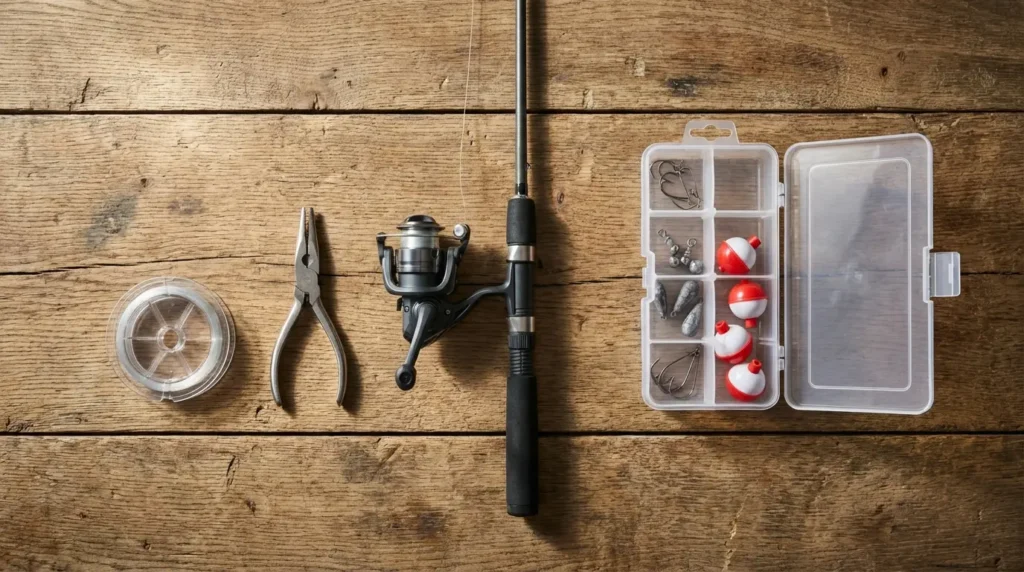
Basic terminal tackle:
- Hooks in sizes 6-10 (smaller number = larger hook)
- Split shot weights (small, removable sinkers)
- Clip-on bobbers/floats
- A few swivels
Tools:
- Needle-nose pliers (essential for removing hooks)
- Nail clippers or line cutters
- A small tackle box to keep everything organised
Bait: Live worms (nightcrawlers) catch almost everything and are available at any bait shop. In the UK, maggots are the standard all-round bait for coarse fishing.
What You Don’t Need Yet
Skip these until you know you’re committed:
- Expensive rods or multiple rod setups
- Baitcasting reels (steeper learning curve, more tangles)
- Fish finders and electronics
- Huge tackle collections
- Braided line (can cut fingers, requires different knots)
- Specialised lures before you’ve mastered basics
Do You Need a Fishing Licence?
Almost certainly yes. This is the item beginners most commonly overlook — or don’t realise exists.
UK: Rod Licence Requirements
Anyone aged 13 or over needs an Environment Agency rod licence to fish for freshwater fish in England and Wales. Here’s what it costs:
| Licence Type | Duration | Cost |
|---|---|---|
| Trout & Coarse (2-rod) | 12 months | £35.80 |
| Coarse fishing | 1 day | £7.30 |
| Junior (ages 13-16) | 12 months | FREE |
| Senior (66+) / Disabled | 12 months | £24.50 |
Children under 13 don’t need a licence. Purchase online at gov.uk — Post Office sales ended in 2023. Fishing without a valid licence can result in fines up to £2,500.
Important: A rod licence gives you the legal right to fish, but you still need permission to fish specific waters. This means day tickets at commercial fisheries, club membership for club waters, or landowner permission for private waters.
Close season: Rivers in England and Wales are closed for coarse fishing from 15 March to 15 June to protect spawning fish. Most stillwaters (lakes and ponds) remain open year-round.
US: State Licence Requirements
Every US state requires a fishing licence, typically for anyone 16 and older (varies by state). Costs range from $15-50 for residents annually, with short-term options available for visitors.
Purchase through your state’s wildlife agency website, at sporting goods stores, or bait shops. Most states offer 2-4 free fishing days per year when no licence is required — perfect for trying the sport.
Understanding Basic Fishing Terminology
Fishing has its own language. Here are the terms you’ll actually encounter:
Casting: The motion of propelling your line, hook, and bait into the water using the rod.
Rigging: Setting up your line with hooks, weights, bobbers, and bait. A “rig” is a specific setup.
Bite: When a fish takes or nibbles at your bait. You’ll feel it as a tug, tap, or see your bobber move.
Strike/Setting the hook: The quick upward motion of the rod to drive the hook into the fish’s mouth when you detect a bite.
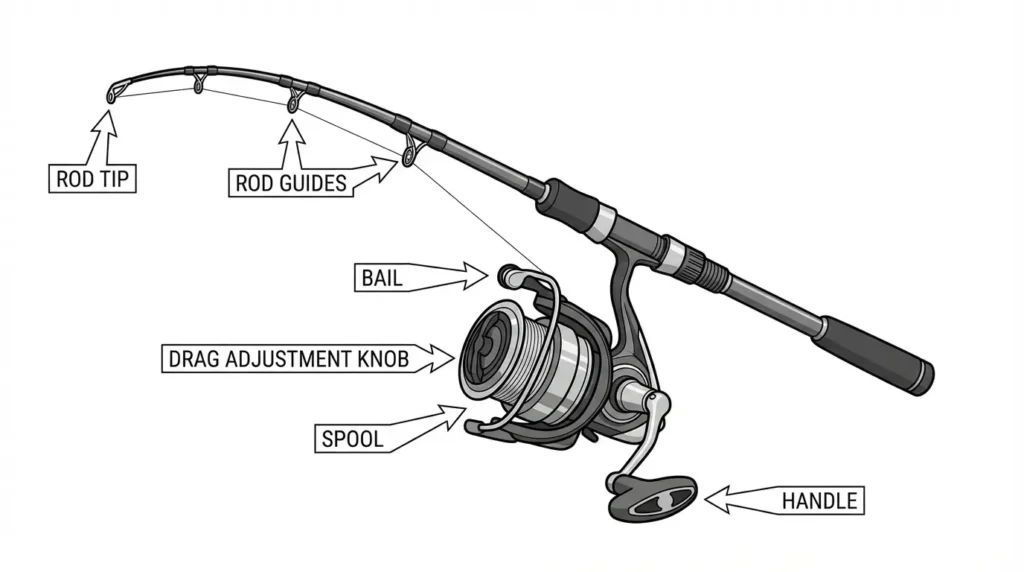
Drag: An adjustable mechanism in the reel that allows line to release under tension. This prevents your line from breaking when a fish pulls hard.
Bail: The wire arm on a spinning reel that guides line onto the spool. You flip it open to cast.
Terminal tackle: Everything at the end of your line — hooks, sinkers, swivels, bobbers.
UK vs US terms: What Americans call a “bobber,” British anglers call a “float.” “Coarse fishing” in the UK means freshwater fishing for non-game species. A “swim” is a British term for a fishing spot.
Choosing Where to Fish
Location matters more than gear. The best equipment in the world won’t catch fish if there aren’t any around.
Best Spots for Beginners
Commercial fisheries and stocked ponds: These exist specifically to provide good fishing. Fish are plentiful, facilities are available, and staff can offer advice. In the UK, day ticket fisheries are the easiest starting point.
Urban park lakes: Often stocked and managed for public fishing. Easy access, usually free or low-cost permits.
Farm ponds: With landowner permission, these often hold excellent populations of panfish and bass.
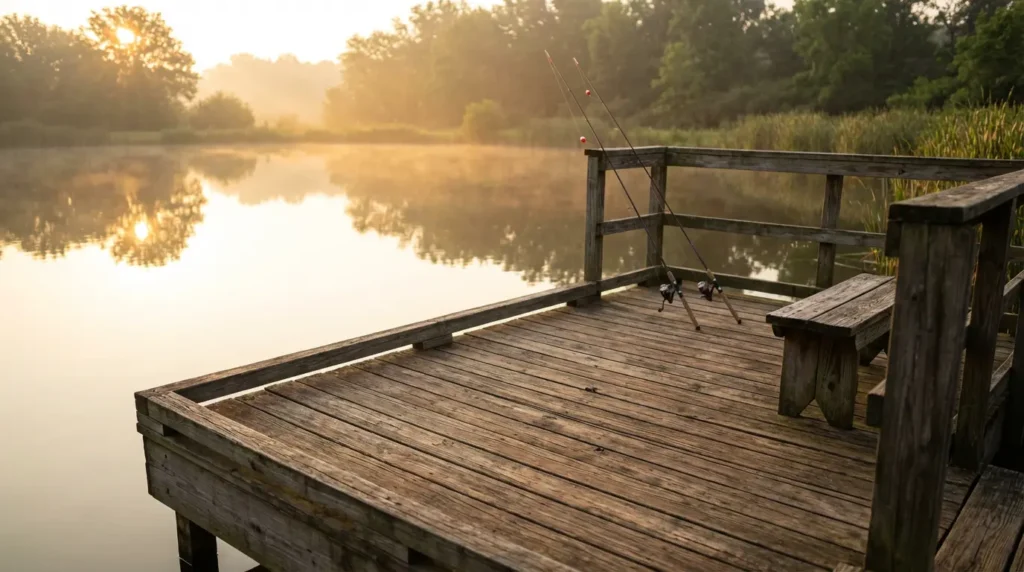
Piers and docks: Provide access to deeper water where fish congregate around structure.
What Makes a Good Fishing Spot
Fish aren’t randomly distributed. They gather near:
- Structure: Fallen trees, rocks, weed edges, docks, bridges
- Depth changes: Where shallow water meets deeper water
- Shade: Especially in warm weather
- Inflows: Where streams enter ponds or lakes
- Cover: Anything that provides protection from predators
Cast near these features rather than into open, featureless water.
The Simplest Fishing Setup That Actually Catches Fish
This is the setup that’s caught more fish than any other: a bobber, a hook, a weight, and live bait.
The Basic Bobber Rig
From your line down:
- Clip-on bobber — attached 2-4 feet above the hook
- Split shot weight — pinched onto the line 6-12 inches above the hook
- Hook — size 6-8 is versatile
- Bait — worm threaded onto the hook
How it works: The bobber keeps your bait suspended at a set depth and provides visual bite indication. When a fish takes the bait, the bobber dips, twitches, or disappears underwater. That’s your cue to set the hook.
Setting the depth: Start with the bobber 3-4 feet above the hook. Your bait should hang just above the bottom or at the depth where fish are feeding. Adjust based on where you’re getting bites.
Making Your First Cast
For spinning reels, here’s the basic overhead cast:
- Hold the rod with the reel hanging below, line threading through the guides
- Let about 6-12 inches of line hang from the rod tip to your bait
- Hook the line with your index finger and open the bail
- Bring the rod back over your shoulder
- In one smooth motion, bring the rod forward and release the line when the rod is pointing toward your target
- Close the bail once your bait hits the water
Your first casts will be awkward. That’s normal. Most people develop a functional cast within 30 minutes to 2 hours of practice.
What to Do When You Get a Bite
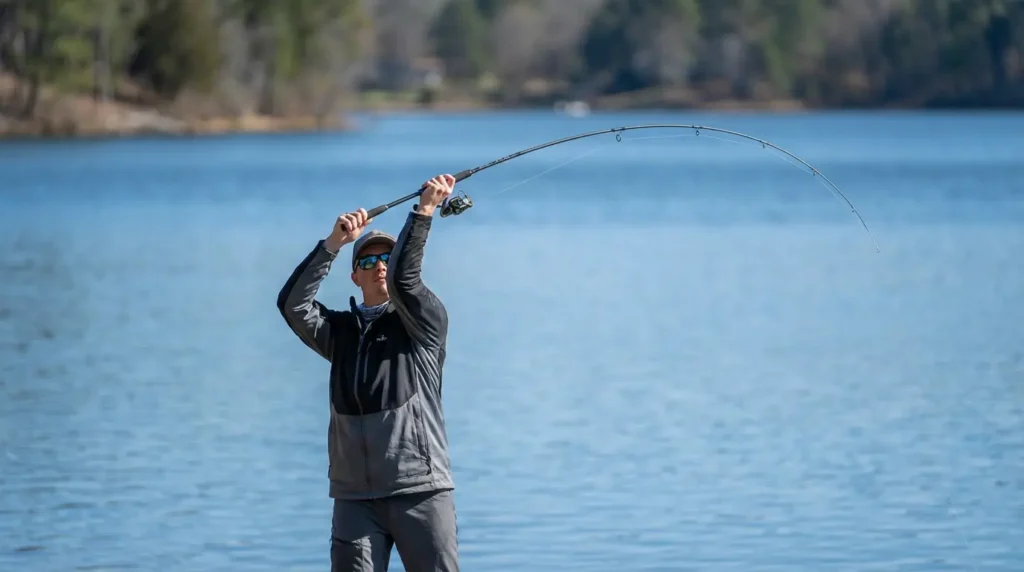
This is the exciting part. When you see your bobber move, dip, or disappear:
- Wait a moment — let the fish take the bait properly. A common beginner mistake is striking too early
- Set the hook — raise your rod tip firmly (not violently) to drive the hook in
- Keep tension — maintain a slight bend in the rod. Slack line lets fish spit the hook
- Reel steadily — bring the fish in with smooth reeling, letting the drag do its job if the fish pulls hard
- Land carefully — guide the fish to shore or into a net
The Best Fish Species for Beginners
Don’t target the most impressive species. Target the most cooperative ones.
UK Beginners
- Roach: Abundant, willing biters, beautiful fish
- Perch: Bold feeders, often found around structure
- Rudd: Surface feeders, often visible in clear water
- Bream: Bottom feeders that school in large numbers
US Beginners
- Bluegill/Sunfish: The perfect starter fish — abundant, eager biters, and found almost everywhere
- Crappie: Excellent eating, often school in good numbers
- Largemouth Bass: Once you have basics down, bass provide exciting fights
- Channel Catfish: Bottom feeders that readily take bait
Common Beginner Mistakes (And How to Avoid Them)
Setting the hook too early: Wait until the bobber fully submerges or you feel solid weight. Fish often mouth bait before committing.
Fishing with slack line: Keep slight tension at all times. You can’t feel bites or set hooks with loose line.
Staying in one spot too long: If you haven’t had a bite in 15-20 minutes, move. Fish are somewhere — you just need to find them.
Fishing the middle of nowhere: Open, featureless water holds few fish. Cast near structure, shade, and cover.
Using dull hooks: Hooks should be sharp enough to catch on your fingernail. Replace or sharpen regularly.
Overcasting: Distance isn’t everything. Many fish are caught close to shore, especially around structure near the bank.
Best Times to Fish
Early morning (6-9 AM): Excellent. Fish are actively feeding as light increases.
Late afternoon to dusk (4 PM onwards): Often the best time. Cooling temperatures trigger feeding.
Overcast days: Clouds reduce glare and make fish less cautious. Some of the best fishing happens under grey skies.
Midday in summer: Typically the slowest time. Fish retreat to deeper, cooler water and feed less actively.
Realistic Expectations for Your First Trips
Here’s what success actually looks like when you’re starting:
First trip: Success means casting without major tangles, keeping bait in the water, and learning from the experience. Catching a fish is a bonus, not the measure of success.
First few trips: You’ll start recognising bites, improving your casting, and understanding how your gear works together.
After 3-5 outings: Most beginners feel genuinely comfortable — casting becomes automatic, you can tie basic knots confidently, and you’re catching fish at least occasionally.
The learning never stops: Even lifelong anglers are constantly learning. That’s part of what makes fishing engaging for decades.
Essential Safety Considerations
Check behind you before casting: Hooks moving at speed cause real injuries. Always look before you cast.
Sun protection: Water reflects UV rays, intensifying exposure. Sunscreen, hat, and sunglasses aren’t optional for longer sessions.
Weather awareness: Never fish during lightning storms. Water and metal rods are dangerous during electrical storms. If you hear thunder, leave the water.
Hook safety: Carry pliers for hook removal. Consider barbless hooks — they’re easier to remove from both fish and fingers.
What’s Next After the Basics?
Once you’re comfortable with bait fishing, you might explore:
- Lure fishing: More active, visual, and versatile
- Different species: Each has its own behaviours and techniques
- Different waters: Rivers, reservoirs, canals, and eventually sea fishing
- Specialised techniques: Float fishing refinements, ledgering, fly fishing
But don’t rush. There’s a lifetime of enjoyment in simply fishing well with basic tackle. Master the fundamentals first.
Final Thoughts
Fishing is one of the few hobbies that costs almost nothing to try, can be done alone or socially, works for all ages and fitness levels, and provides genuine connection to the natural world.
The best way to learn is simply to go fishing. You’ll make mistakes, lose some tackle, and probably come home empty-handed once or twice. That’s all part of the process.
The skills come with time on the water. The memories start from your very first cast.
Ready to Start?
Our Kids Fishing Starter Kit isn’t just for kids — it’s sized for easy learning and includes everything in this guide: rod, reel, pre-spooled line, and an organised tackle selection. Perfect for families getting into fishing together.